
Parents often look for natural ingredients because they want hair care to feel safer, simpler and more familiar. Ingredients like aloe vera, amla, bhringraj and argan oil have strong recognition in Indian personal care. While no single ingredient can do everything, the right blend can help hair feel softer, smoother and easier to comb. The complete formula still matters more than one hero ingredient on the label.
Why this topic matters for parents
Parents today see many claims on kids care products, and it can become confusing to separate helpful guidance from marketing noise. The best approach is to think about the child’s daily life: school, sports, sweat, dust, bathing, hair washing, moisturising, and comfort. A product or habit should make that routine easier, safer-feeling and more consistent. When parents understand aloe vera, amla, bhringraj, argan oil, they can choose with confidence instead of fear.
Keep the routine age-appropriate
School-age children do not need adult beauty routines. They need gentle cleansing, sensible moisturising, clean hair and habits they can repeat. The routine should be short enough for busy mornings and calm enough for evenings after homework or play. If a child resists, simplify the steps rather than adding more. A practical routine that happens regularly is always better than a perfect routine that nobody follows.
Aloe vera, amla, bhringraj and argan oil
Aloe vera is often used for a soothing, hydrating feel. Amla has a long history in Indian hair care and is associated with traditional hair routines. Bhringraj is another familiar botanical in Indian hair care conversations. Argan oil is valued for softness, smoothness and a conditioned feel. In a kids shampoo, these ingredients should be part of a gentle overall formula rather than used as exaggerated miracle claims.
Natural-inspired but science-aware
Natural ingredients can be wonderful, but natural does not automatically mean suitable for every child. A formula must still be gentle, stable, preserved and pleasant to use. Parents should avoid products that promise unrealistic results. For children, the most meaningful benefits are simple: clean scalp, softer-feeling hair, easier combing and a comfortable routine.
Look at the complete formula
One ingredient or one claim never tells the full story. A good product is a balanced formula where cleansing agents, moisturisers, conditioners, fragrance, preservatives and pH all work together. Natural ingredients can be comforting and familiar, but the full formula still matters. A product should be pleasant to use, easy to rinse, properly preserved and suitable for the purpose printed on the label.
Gentle does not mean ineffective
Many parents think a gentle product may not clean well, but that is not always true. Gentle simply means the product is designed to do its job without unnecessary harshness. A kids body wash can clean sweat and dust without leaving the skin tight. A kids shampoo can remove scalp buildup without making hair rough. A lotion can support softness without feeling sticky. The goal is balance.
Build habits children understand
Children cooperate better when they understand the reason behind a step. Instead of saying “use lotion because I said so,” explain that skin can feel dry after bathing and lotion helps it feel comfortable. Instead of forcing shampoo quickly, teach them that the scalp needs cleaning because sweat and dust collect there. Simple explanations make self-care feel normal, not like punishment.
Common mistakes to avoid
The most common mistakes are using too much product, scrubbing too hard, using very hot water, skipping moisturiser, washing hair only by rubbing the hair length instead of the scalp, and changing products too frequently. Another mistake is assuming that more foam means better cleansing. With children, less can often be more: a small amount used correctly, a short routine done daily, and patient teaching.
How NOMARA Kids fits this thinking
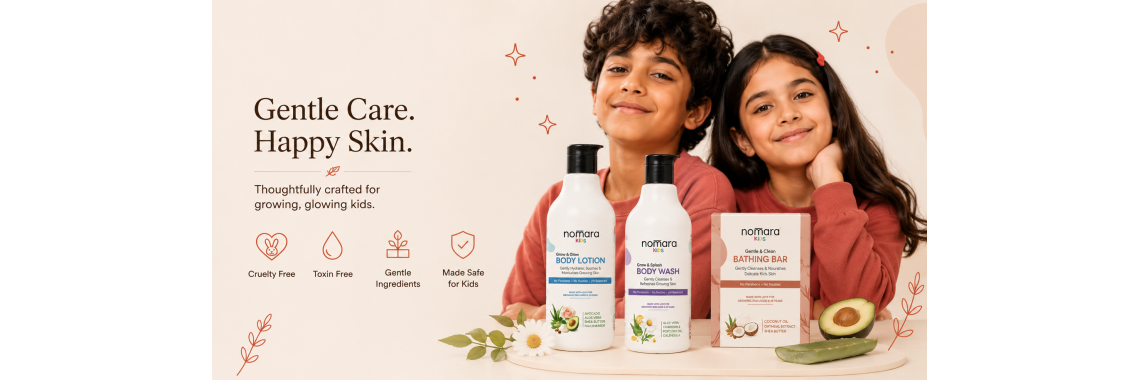
NOMARA Kids is built around the idea that children above five need care that feels premium, gentle and practical. The focus is not on complicated adult-style routines. It is on everyday bath, skin and hair care with thoughtful ingredients, soft sensory experience and parent-friendly choices such as sulphate-free and harsh-chemical-free positioning. The routine should feel easy for parents and comfortable for children.
A simple checklist
Before buying or using any kids care product, ask a few simple questions. Is the product meant for children? Is the purpose clear? Does the child like using it? Does the skin or scalp feel comfortable afterwards? Is it easy to use regularly? Are the claims understandable? This checklist keeps parents grounded and reduces confusion.
Final takeaway
Healthy care for children is built through everyday consistency. One bath will not change everything and one missed step is not a disaster. What matters is the pattern: gentle cleansing, comfortable moisturising, careful hair washing, patient detangling and a calm attitude toward hygiene. When children grow up with simple self-care habits, they learn to respect their bodies without feeling pressured by adult beauty standards.
Parent-friendly conclusion
Children’s care should feel gentle, consistent and realistic. Whether the topic is skin, hair, labels or hygiene habits, the best routine is one that parents can repeat and children can accept. Choose products thoughtfully, avoid unnecessary harshness, and keep the focus on comfort rather than perfection. Small everyday habits create the biggest long-term difference.
Daily care reminders
Keep the routine calm and positive. Children learn from repetition, so the same small steps matter more than occasional intense care. Store products in the same place, use only the required amount, rinse well, and notice how the child’s skin or hair feels after the routine. If something causes discomfort, stop using it and review the product, the amount, the water temperature and the way it is being applied. Parents do not need to chase every trend. A gentle, well-labelled and age-appropriate product used consistently is usually the most practical choice for everyday family life.
Daily care reminders
Keep the routine calm and positive. Children learn from repetition, so the same small steps matter more than occasional intense care. Store products in the same place, use only the required amount, rinse well, and notice how the child’s skin or hair feels after the routine. If something causes discomfort, stop using it and review the product, the amount, the water temperature and the way it is being applied. Parents do not need to chase every trend. A gentle, well-labelled and age-appropriate product used consistently is usually the most practical choice for everyday family life.
Comments
Write a comment